

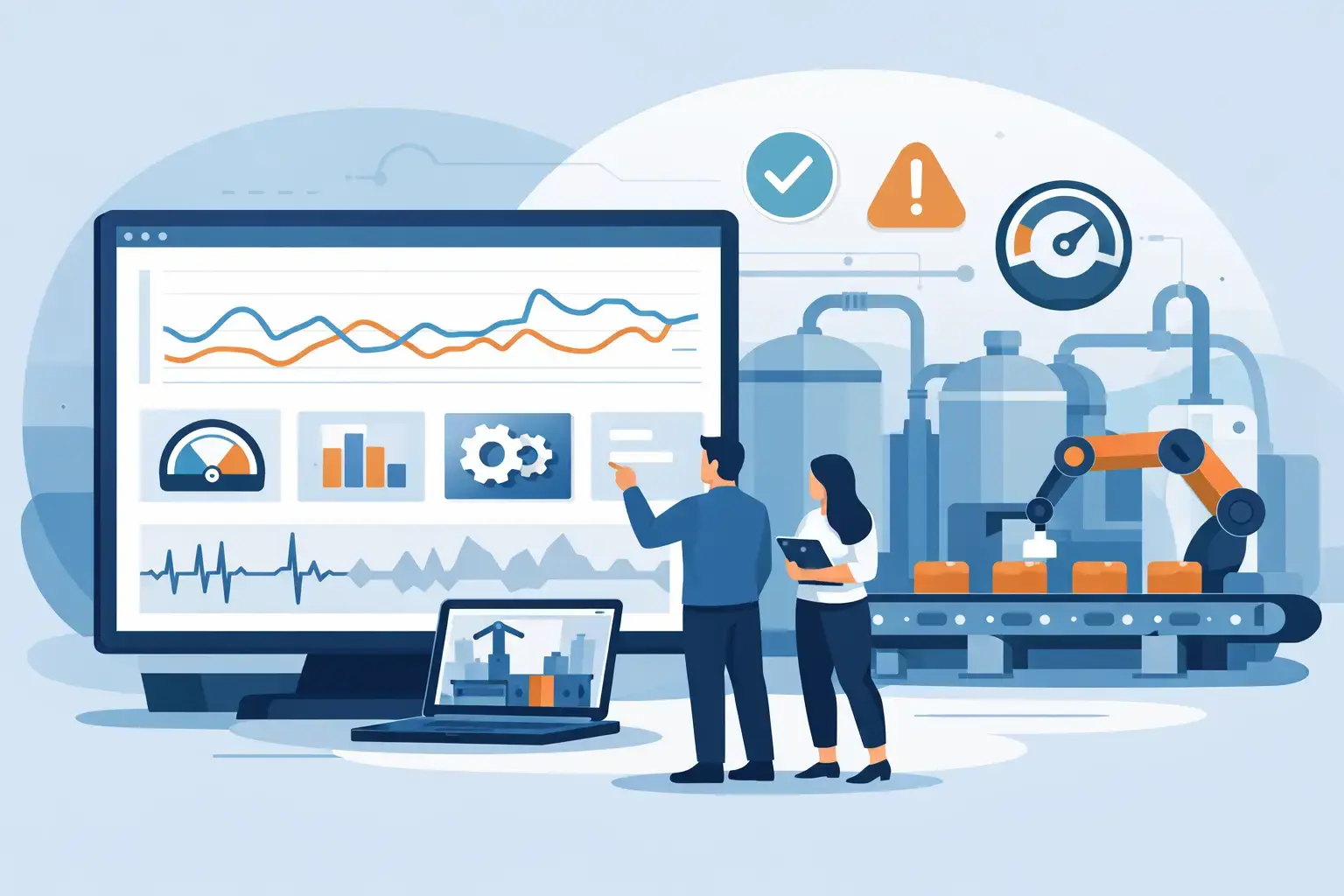
A kiln drifts off target at 2:13 a.m. The control room sees the temperature move, but by the time someone confirms the pattern, checks upstream conditions, and decides what to do, yield has already taken a hit. That gap between signal and action is exactly where real time process monitoring software earns its value.
In heavy industry and process manufacturing, the issue is rarely a lack of data. Plants already have historians, PLCs, SCADA systems, lab systems, MES platforms, and spreadsheets full of production records. The real problem is that most operations still struggle to turn those fragmented signals into timely, plant-level decisions. Real time process monitoring software closes that gap by bringing live process data into context, identifying what matters now, and giving teams the visibility to respond before losses compound.
What real time process monitoring software actually does
At its core, this software tracks process variables as production is happening and presents them in a way that operators, engineers, and plant leaders can use. That sounds simple, but the difference between basic monitoring and operationally useful monitoring is significant.
A trend chart alone is not enough. Useful monitoring software combines live data ingestion, contextualization, alarms, process views, event tracking, and analytics that reflect how the plant really runs. It should connect temperature, pressure, flow, vibration, energy, quality, throughput, and asset condition into a single operational picture rather than leaving each signal isolated in its own system.
For a process engineer, that means seeing how a deviation in one unit affects downstream quality. For a plant director, it means understanding whether a shift in process stability is creating measurable production loss. For a digital leader, it means building a data foundation that can support not just dashboards, but prediction and closed-loop automation.
Why manufacturers outgrow basic monitoring tools
Many plants start with HMIs, historian views, and equipment-level dashboards. Those tools are useful, but they were not designed to solve cross-process optimization problems at scale. They tell you what one machine is doing. They do not always tell you why the line is unstable, which variables matter most, or how to act fast across multiple assets and plants.
That limitation becomes expensive in sectors like steel, cement, chemicals, food processing, mining, and pharma, where small deviations can trigger major losses. A slight process drift may increase scrap, raise energy consumption, reduce throughput, or create off-spec product long before a hard alarm goes off. If teams only see symptoms instead of interactions, they react late and often overcorrect.
Real time process monitoring software becomes more valuable as process complexity increases. The more interdependent the operation, the more important it is to monitor the full production context rather than a single tag or subsystem.
What good real time process monitoring software should include
The first requirement is data integration. If the software cannot work across historians, PLCs, MES, quality systems, and manual inputs, it will create one more silo instead of solving the existing ones. Industrial teams need a unified view across assets, production lines, and utility systems.
The second requirement is contextualization. Raw signals have limited value on their own. A pressure spike means something different during startup than it does in steady-state production. The software should account for grades, recipes, shifts, asset states, and operating modes so teams are not comparing apples to oranges.
The third is real-time analytics that go beyond threshold alarms. Static alarm limits still matter, but many process losses begin inside the "acceptable" range. Advanced monitoring should identify abnormal patterns, process drift, and combinations of variables that indicate instability before the problem is obvious.
The fourth is operational usability. If the interface is built only for data scientists, adoption will stall. Operators need clear process views. Engineers need traceability and root-cause support. Managers need KPI visibility tied to production, quality, and energy performance. The best systems serve all three without forcing each group into a different tool.
Finally, there is scalability. A pilot on one line is easy. Standardizing monitoring across plants, equipment types, and business units is much harder. Software should support repeatable deployment, governance, and user access without becoming a custom project every time.
Where the ROI shows up fastest
The financial case for monitoring software is usually strongest where process instability is already visible but poorly controlled. That may mean frequent quality give-away, excess fuel consumption, bottlenecks, unplanned stops, or inconsistent operator response.
In process industries, the gains are often cumulative rather than dramatic in one single metric. A few points of improved yield, a modest reduction in energy intensity, fewer off-spec batches, faster root-cause analysis, and tighter control of critical parameters can add up quickly. Plants with high throughput do not need huge percentage improvements to generate meaningful return.
That said, ROI depends on what the software actually changes. If it becomes a passive dashboard layer, results will be limited. If it helps teams detect deviations earlier, standardize response, and feed better inputs into optimization or control strategies, the payback can be fast.
Real time monitoring versus AI optimization
This is where many buying teams need clarity. Monitoring and AI are related, but they are not the same thing.
Monitoring software tells you what is happening now and helps you catch process issues early. AI optimization goes a step further by identifying what should happen next - whether that is recommending setpoint changes, predicting quality outcomes, or automating control decisions under defined constraints.
The strongest industrial platforms combine both. They create a live operational layer that supports visibility today and better decision-making tomorrow. Without real-time monitoring, AI models lack context and trust. Without AI, monitoring may improve awareness but stop short of delivering full process optimization.
For that reason, manufacturers should be cautious about point solutions that solve only a narrow dashboard problem. If the long-term goal is plant-scale performance improvement, the monitoring layer should support future analytics, model deployment, and operational control.
Common buying mistakes
One common mistake is choosing software based mainly on dashboard appearance. Clean visualization matters, but a polished interface will not compensate for poor integration, weak industrial context, or limited scalability.
Another is underestimating deployment realities. Plants need software that can work with legacy systems, mixed vendor environments, and imperfect data. In industrial operations, the best solution is rarely the one that assumes a perfect digital foundation. It is the one that can create value in the environment you actually have.
A third mistake is treating monitoring as an IT project instead of an operations program. The software should support measurable plant outcomes, not just data access. That means success criteria should be tied to throughput, downtime, quality, yield, energy, or operator effectiveness from the start.
How to evaluate real time process monitoring software
Start with the operational problem, not the feature list. Ask where process losses occur, how quickly teams detect them today, and what decisions are delayed because data is fragmented or unclear. That will tell you whether you need simple visibility, event detection, predictive insight, or a platform that can grow into closed-loop control.
Then test the software against your plant reality. Can it ingest live industrial data from multiple systems? Can it contextualize process states and product conditions? Can it support operators and engineers in the same workflow? Can it scale beyond a pilot site? And can it show value in weeks or months rather than disappearing into a long integration cycle?
It is also worth asking who owns the outcome after deployment. In manufacturing, software value does not come from installation alone. It comes from sustained use, clear governance, and a path from insight to action. That is why many industrial teams look for partners that understand process behavior, not just software architecture. Platforms such as Wizata are built around that reality, connecting industrial data, AI development, and operational control so manufacturers can move from visibility to measurable improvement at scale.
The real standard is action, not visibility
Plenty of systems can show that a process is unstable. Fewer can help a plant respond fast enough to protect margin. That is the standard that matters.
If your teams are still switching between historians, control screens, reports, and tribal knowledge to understand what is happening, the issue is not data volume. It is decision latency. Real time process monitoring software is most valuable when it reduces that latency across the plant and turns live process signals into better operational control.
The plants that win with it are not the ones chasing prettier dashboards. They are the ones building a practical path from raw data to timely action, one process loss at a time.


