

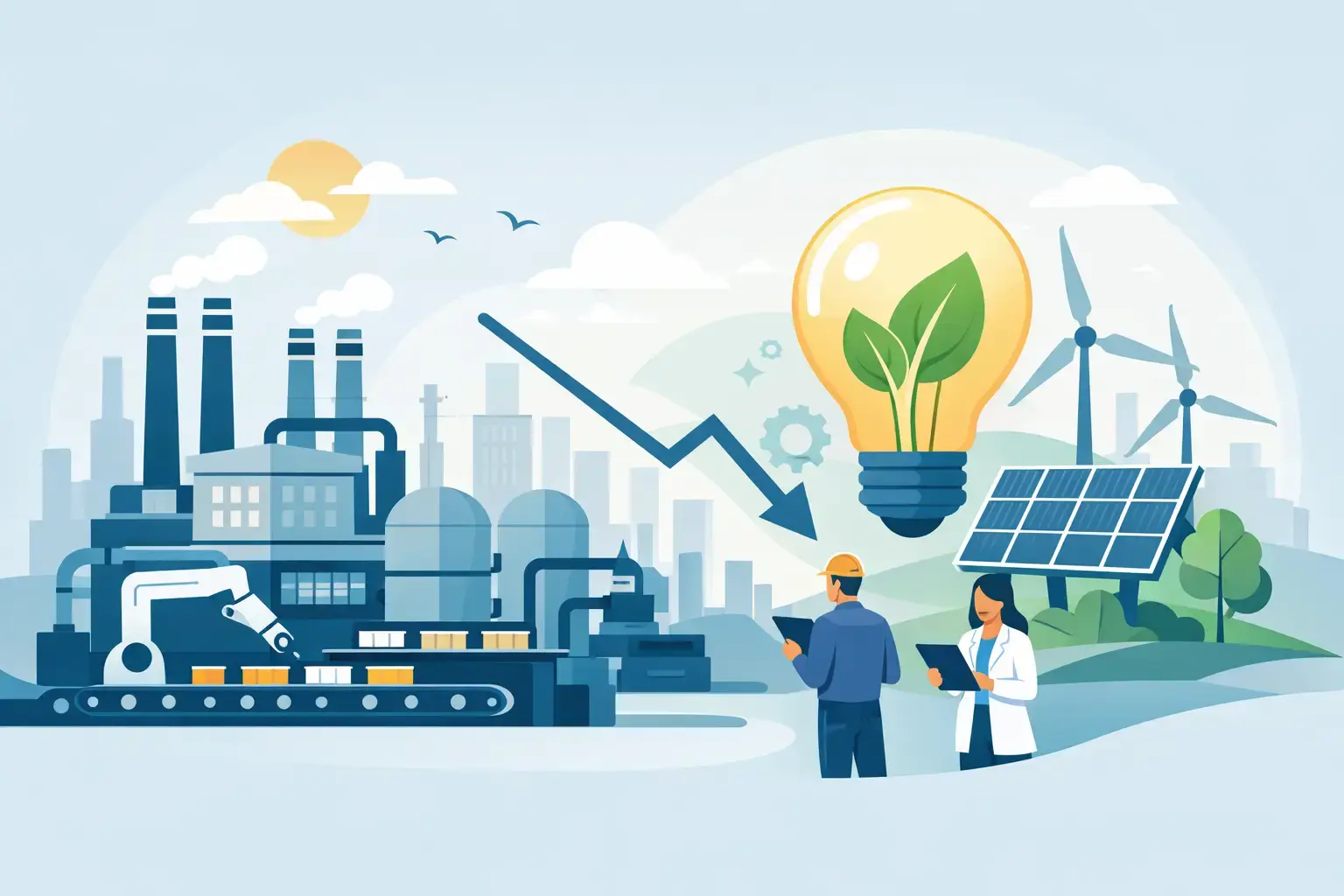
For most manufacturers, industrial decarbonization trends are no longer a separate sustainability workstream. They are becoming operating decisions: how much fuel a kiln consumes per ton, whether a furnace runs within its best energy window, how often off-spec product is reprocessed, and which assets receive limited low-carbon power first. The plants making progress are not waiting for a single breakthrough technology. They are reducing avoidable losses now while building the data, control, and capital plans required for deeper emissions cuts.
The practical question is not whether a site can set a net-zero target. It is whether operations can lower carbon intensity without sacrificing throughput, quality, reliability, or margin. That requires a more disciplined approach than reporting emissions after the fact. It requires managing the process variables that create them.
Industrial Decarbonization Trends Moving Into Operations
Energy efficiency is back at the center
Efficiency is often treated as the unglamorous first step before electrification, hydrogen, or carbon capture. In practice, it is the work that makes every later investment more economic. A plant that reduces heat losses, stabilizes combustion, minimizes idle time, and improves yield needs less energy per unit of saleable output - regardless of the energy source.
This is particularly material in cement, steel, lime, chemicals, mining, and other heat-intensive processes. Small changes in setpoints, feed quality, moisture, oxygen levels, refractory condition, or production scheduling can create substantial fuel and electricity effects at scale. The challenge is that these drivers rarely sit in one system. They are distributed across historians, laboratory systems, quality records, maintenance logs, utility meters, and operator knowledge.
The trend is toward connecting those signals and using them to identify the true operating envelope for lowest-cost, lowest-carbon production. That moves energy management from a monthly utility review to a daily production discipline.
Electrification is selective, not universal
Industrial electrification is advancing quickly, but the business case varies sharply by process. Motors, pumps, compressors, low-temperature heat, material handling, and some boilers may offer near-term opportunities. High-temperature process heat is more complex, particularly where electricity prices, grid constraints, equipment availability, and product specifications limit options.
This is why leading manufacturers are prioritizing applications by process economics rather than by technology headlines. An electric asset can reduce direct emissions while increasing operating cost or shifting emissions upstream if the power supply is carbon intensive. Conversely, flexible electric loads can become valuable where renewable power contracts, onsite generation, storage, or demand-response programs are available.
The operational requirement is better visibility. Plants need to understand when energy is consumed, what production result it produces, and how that relationship changes by product grade, weather, raw material, and equipment condition. Without that context, electrification can create a new source of variability rather than a controlled emissions reduction program.
Carbon accounting is becoming production accounting
Annual corporate emissions inventories remain necessary, but they are too slow and too aggregated to improve a shift, line, or asset. Manufacturers increasingly need product-level and batch-level carbon data that can stand alongside cost, quality, yield, and delivery performance.
That shift matters commercially. Customers are asking for credible product carbon footprints. Procurement teams need to compare suppliers and raw materials. Operations teams need to see the carbon cost of scrap, rework, unplanned shutdowns, and lower-grade output. Once carbon is visible at the production level, it becomes possible to make trade-offs deliberately instead of treating emissions as an external reporting metric.
Data quality remains the limiting factor. Meter readings alone do not explain allocation across products, lines, or intermediate materials. The calculation must account for production context, material flows, energy sources, inventory changes, and process losses. Manufacturers should begin with decisions they need to improve, not with an attempt to build a perfect carbon model for every asset on day one.
The Highest-Value Lever Is Process Stability
Decarbonization projects can fail when they focus only on the energy source and overlook how the process is operated. Variability is expensive in every direction. It increases energy use, drives off-spec material, raises maintenance stress, and forces operators to run with extra safety margins.
Consider a thermal process with unstable feed characteristics. Operators may increase fuel input to protect quality, then correct when temperatures overshoot. The average consumption can look acceptable while the process wastes energy through constant correction. Similar patterns occur in compressed-air systems, steam networks, grinding circuits, furnaces, distillation columns, and refrigeration systems.
AI and advanced analytics can help when they are applied to a defined operational decision. Models can forecast quality or energy demand, detect conditions associated with excessive consumption, recommend setpoint adjustments, or automate repeatable control actions within approved constraints. The objective is not to replace operators. It is to give them a reliable, real-time view of what the process is likely to do next and how to keep it within its best operating range.
For this to scale, the model must be connected to industrial data and embedded in the workflow where decisions happen. A dashboard that identifies an opportunity after production is complete has limited value. A solution that turns data into a recommendation, tracks operator response, and safely closes the loop can deliver repeatable performance improvement.
Capital Decisions Are Shifting Toward Flexible Pathways
Deep decarbonization technologies can require major capital and long development cycles. Hydrogen, carbon capture, alternative binders, direct reduced iron, new electrified process routes, and biomass conversion all have a role in specific sectors. But the timing depends on infrastructure, permitting, policy, offtake agreements, raw-material availability, and regional energy markets.
That uncertainty is changing investment logic. Rather than making a single irreversible bet, manufacturers are sequencing decisions. They first reduce baseline consumption, instrument critical processes, improve data reliability, and create operational flexibility. Then they can evaluate larger technology investments using plant-specific evidence rather than generic assumptions.
This approach also protects production economics. If a site cannot quantify its current energy losses, downtime drivers, and quality costs, it cannot accurately value the benefit of a new fuel or electrified process. The most credible capital cases combine engineering assumptions with observed operational performance.
What Industrial Leaders Should Do Now
The strongest decarbonization programs start with a small number of high-value operating problems. A useful first portfolio may include a fuel-intensive line with high variability, a utility system with poor visibility, an asset that drives recurring quality loss, and a process where operators depend on manual adjustment during changing conditions.
For each use case, define a baseline that operations recognizes: energy per ton, fuel per batch, scrap rate, yield, throughput, unplanned downtime, or carbon intensity per unit. Then identify the controllable drivers and the data needed to act on them. This keeps the program attached to plant performance rather than abstract digital ambition.
Three implementation choices determine whether early wins become a scalable capability. First, build a unified and contextualized industrial data foundation rather than creating a new point solution for every use case. Second, involve process engineers and operators from model design through deployment, because they understand the constraints a purely statistical model will miss. Third, measure value after deployment, including whether recommendations are adopted and whether gains persist across shifts, grades, and sites.
Wizata's approach reflects this operating model: connect fragmented production data, develop industrial AI against real process constraints, and deploy it through operational interfaces that teams can use at plant scale. The result should be measurable performance improvement, not another pilot that remains isolated from production.
A Better Test for Every Decarbonization Project
Before approving a project, plant leaders should ask a direct question: will this make the operation more controllable as well as lower carbon? The best initiatives reduce emissions while improving process stability, yield, energy intensity, and decision speed. Projects that create new operating complexity may still be necessary, but their control and data requirements need to be funded as part of the investment.
The plants that move fastest will treat decarbonization as a performance program with emissions outcomes, not a reporting program with operational side effects. Start where wasted energy, unstable quality, and avoidable losses already constrain the business. Every ton of energy avoided through better control creates room to make the harder, longer-term transition choices with greater confidence.


