

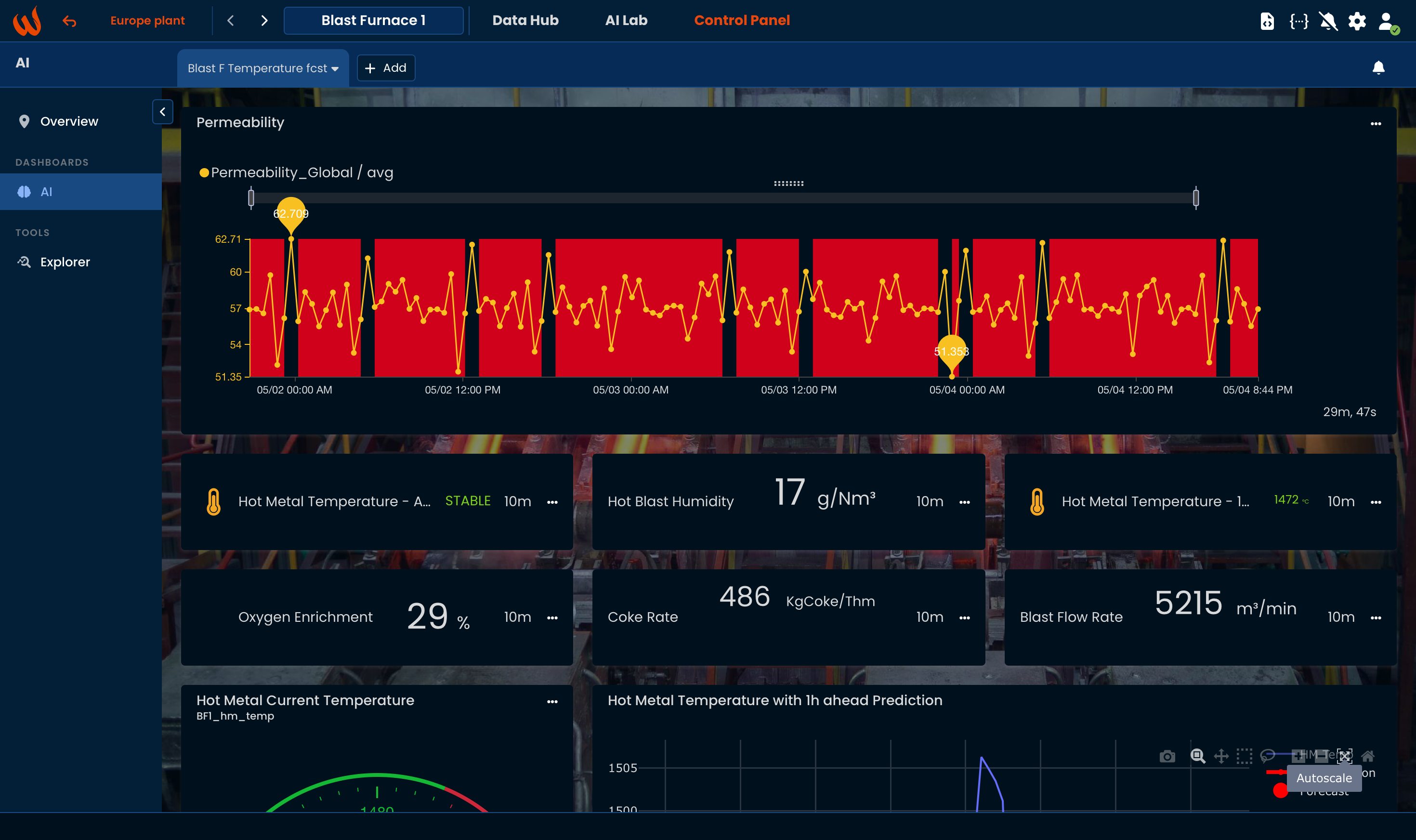
A kiln operator sees draft pressure drifting while fuel use climbs. A rolling mill crew faces a quality trend that is still within specification but moving in the wrong direction. A process engineer knows the answer may exist in historian data, laboratory results, maintenance records, and shift logs, but not quickly enough to protect the next production hour. Operator decision support software is built for this moment: turning complex plant data into timely, contextual guidance that people can use at the point of operation.
For industrial manufacturers, the issue is not a lack of data. It is the gap between data collection and confident action. Plants may have thousands of tags, years of historical records, dashboards for every function, and still depend on experienced operators to manually detect weak signals across a changing process. The cost appears as excess energy, unstable throughput, lost yield, avoidable quality variation, and slower recovery after disturbances.
What Operator Decision Support Software Must Deliver
Decision support should not be another screen that asks operators to interpret more charts. It should combine real-time process conditions with historical behavior, production context, operating constraints, and the plant's performance objectives. The output must answer a practical question: what should change now, why, and what is the expected impact?
That requires more than a generic analytics layer. In process manufacturing, the same temperature, pressure, or flow value can mean different things depending on the product grade, raw-material quality, equipment condition, upstream variability, and current operating target. A recommendation without that context can be technically plausible and operationally wrong.
Effective systems connect data from control systems, historians, laboratory information systems, maintenance platforms, quality databases, and production records. They establish a usable data foundation, then apply process models, machine learning, and rules to identify the operating conditions associated with better outcomes. The operator receives recommendations in the language of the process, not a data science experiment.
Recommendations Need an Operating Envelope
Plants do not optimize a single number in isolation. Increasing throughput may raise energy consumption. Reducing fuel use may affect quality or emissions. A recommendation that improves one metric while pushing the process toward an unsafe or unstable state is not decision support.
The best operator decision support software works within defined operating envelopes. It accounts for safety limits, quality specifications, equipment constraints, production plans, and the trade-offs agreed by operations and engineering. Rather than prescribing a theoretical optimum, it recommends the best feasible action for current plant conditions.
This distinction matters when conditions change. A model trained on one raw material blend, one product grade, or one season may need to adapt when the process shifts. Continuous monitoring, model governance, and clear ownership are essential. Operators should be able to see recommendation status, give feedback, and understand when the system is confident enough to advise action.
From Alarms to Better Operating Decisions
Traditional alarm systems are necessary, but they are designed primarily to warn of deviations and protect the process. They do not always explain the chain of events leading to a developing loss. A high alarm tells an operator that a limit has been reached. Decision support can identify the conditions that are making that limit more likely and recommend a controlled adjustment before the loss escalates.
Consider a grinding circuit with rising energy per ton. The cause may not be a single equipment fault. It may reflect ore hardness, feed size distribution, circulating load, liner condition, mill speed, or a change in downstream demand. A dashboard can show each signal. A decision support system can evaluate their combined effect and guide the operator toward the adjustment most likely to restore performance.
That guidance does not remove operator judgment. It makes judgment more consistent, especially across shifts and sites. Experienced personnel retain the ability to challenge a recommendation, account for work in progress, and respond to conditions that are not yet visible in data. The software provides a shared, evidence-based operating view rather than replacing process expertise.
Where the Business Value Appears First
The strongest use cases begin with a costly, repeatable operating decision. In cement and lime, that may be stabilizing kiln operation while reducing thermal energy. In metals, it may be improving yield and quality consistency during casting, rolling, or heat treatment. In chemicals, it can mean holding a process closer to target despite feedstock variability. In food and beverage or pharma, it may center on reducing quality deviations and minimizing rework without compromising compliance.
The financial case should be explicit. If a system recommends adjustments that reduce specific energy consumption, the plant should be able to compare baseline and post-deployment performance while accounting for production mix and external conditions. If the goal is yield, the measurement should distinguish a genuine process improvement from a change in demand or material input.
Value also comes from faster response. When an operator can recognize a developing deviation 30 minutes earlier and apply a validated corrective action, the plant may avoid an entire cycle of off-spec material or inefficient operation. Those small decisions compound across shifts, lines, and plants.
Deploying Decision Support Without Creating Another Pilot
A common failure pattern is to build an impressive model around a narrow data set, demonstrate it once, and struggle to move it into daily operations. The technical model may be sound, but the deployment lacks integration with plant workflows, a clear business owner, or a path to replicate the use case elsewhere.
Start with a process area where the economic opportunity is material, the operating variables are controllable, and performance can be measured. Define the decision to improve before selecting algorithms. For example, the objective might be to recommend setpoint adjustments that lower fuel consumption while maintaining clinker quality and production rate. That is more actionable than a broad goal to "use AI for the kiln."
Next, prepare the industrial data. Tags need reliable time alignment, quality checks, contextual labeling, and a consistent asset structure. Laboratory results, production states, and operator actions often matter as much as high-frequency sensor data. Without that context, a model can mistake correlation for a usable operational relationship.
The recommendation must then reach the right user in the right workflow. Some plants need a control-room interface that surfaces priority actions and expected benefits. Others need a process-engineering view for validation and ongoing tuning. In higher-maturity cases, approved recommendations can feed closed-loop control logic, with safeguards and human oversight appropriate to the process risk.
Scale is designed from the beginning. Standard data models, reusable AI components, role-based governance, and a deployment process that plant teams can own all reduce the effort required to expand from one line to many. Wizata's approach combines the data layer, AI development environment, and operational control interface needed to make that progression practical at plant scale.
How to Evaluate Operator Decision Support Software
Evaluate a platform by how well it supports operating outcomes, not by the length of its feature list. Ask whether it can integrate the plant's existing data sources without forcing a single equipment vendor model. Confirm that engineers and data teams can develop, validate, deploy, monitor, and improve solutions while retaining control of their intellectual property.
Also examine the operator experience. Recommendations should be prioritized, explainable, and connected to controllable variables. A system that produces dozens of low-confidence alerts will be ignored. A system that identifies the few actions with measurable impact, shows the supporting process context, and captures operator feedback has a far better chance of becoming part of the shift routine.
Finally, insist on a measurement plan. Baselines, target metrics, adoption indicators, and financial impact should be agreed before deployment. It depends on the process, but typical measures include energy per unit, yield, quality variance, throughput stability, downtime exposure, and time to recover from a deviation. Clear measurement protects the investment and focuses every team on performance.
The most useful decision support does not make a plant feel more digital. It helps operators make better choices while there is still time to change the outcome. That is where industrial AI earns its place on the production floor.


